-->

Monday, October 21, 2013

Example of FindByValue method in ASP.NET

Introduction

Searches the collection for a ListItem with a Value property that contains the specified value (According to msdn library).
Lets take an simple example to remove item from DropdownList using FindByValue method. Basically this method works on collection.
Algorithm behind the scene is
Step-1 : Bind DropdownList with some values
Step-2 : Drop TextBox and Button control to the design page.
Step-3:  First check the capacity of the DropdownList is more than 0 . if capacity is more than 0 then remove the item from the list using FindByValue( ) method.
Step-4: End Program.

Complete code of the program is

<%@ Page Language="C#" %>

<!DOCTYPE html PUBLIC "-//W3C//DTD XHTML 1.0 Transitional//EN" "http://www.w3.org/TR/xhtml1/DTD/xhtml1-transitional.dtd">

<script runat="server">

    protected void Button1_Click(object sender, EventArgs e)
    {
        string item = TextBox1.Text;
        if (DropDownList1 .Items .Capacity >0)
        {
            DropDownList1.Items.Remove(DropDownList1.Items.FindByValue(item));
        }
       
    }
</script>

<html xmlns="http://www.w3.org/1999/xhtml">
<head runat="server">
    <title></title>
</head>
<body>
    <form id="form1" runat="server">
    <div>
        <asp:DropDownList ID="DropDownList1" runat="server" Height="20px" Width="124px">
            <asp:ListItem>Hyperlink</asp:ListItem>
            <asp:ListItem>CheckBox</asp:ListItem>
            <asp:ListItem>Label</asp:ListItem>
            <asp:ListItem>Panel</asp:ListItem>
        </asp:DropDownList>
        <br />
        <br />
        Item to be removed from Dropdownlist:<br />
        <asp:TextBox ID="TextBox1" runat="server" Width="186px"></asp:TextBox>
        <br />
        <br />
        <asp:Button ID="Button1" runat="server" Text="Remove Item "
            onclick="Button1_Click" />
        <br />
        <br />
    </div>
    </form>
</body>

</html>
Output
Bind DropdownList in asp.net

Remove item from dropdownlist using textbox value

Remove item from FindByValue method

How to use SqlDataReader class in ASP.NET

Introduction

Provides a way of reading a forward-only stream of rows from a SQL Server database (according to msdn library). Means you can say a SqlDataReader class read DataRows in forward only stream. SqlDataReader class available in  System.Data.SqlClient namespace.

There are some useable public properties available in Library

 1. HasRows : You can check that your DataReader either empty or take some DataRows.
 2. FieldCount : Obtains numbers of fields in current rows.

There are some public method available in Library

Read( ) : Read Next record from the database table.
GetValue( ) : Gets the value of the specified column in its native format.

Lets take an simple example to read data from database_table using SqlDataReader class.

Algorithm behind the example

Step-1 : Create a SqlConnection( ) with proper connection string parameter.

SqlConnection con = new SqlConnection();
        con.ConnectionString =ConfigurationManager.ConnectionStrings ["ConnectionString"].ToString ();

        con.Open ();

Step-2 : Retrieve data from Database table using SqlCommand Class.

SqlCommand cmd = new SqlCommand();
        cmd.CommandText = "select * from deltable";

        cmd.Connection = con;

Step-3 : Create a SqlDataReader, you must call the ExecuteReader method of the SqlCommand object, instead of directly using a constructor.

SqlDataReader rd = cmd.ExecuteReader();

Step-4: Read data from Read() method 

while (rd.Read())
        {

            snolabel.Text += "sno=" + rd.GetValue(0) + "<br/>";
            name.Text += "name=" + rd.GetValue(1) + "<br/>";
            Addlabel.Text += "Address=" + rd.GetValue(2) + "<br/>";
 
        }
 Step-5: Close reader.

Complete code


   <%@ Page Language="C#" AutoEventWireup="true" CodeFile="binding.aspx.cs" Inherits="binding" %>

<!DOCTYPE html PUBLIC "-//W3C//DTD XHTML 1.0 Transitional//EN" "http://www.w3.org/TR/xhtml1/DTD/xhtml1-transitional.dtd">

<html xmlns="http://www.w3.org/1999/xhtml">
<head runat="server">
    <title></title>
</head>
<body>
    <form id="form1" runat="server">
    <asp:Button ID="Button1" runat="server" onclick="Button1_Click" Text="GetData"
        Width="123px" />
    <br />
    <br />
    <asp:Label ID="snolabel" runat="server"></asp:Label>&nbsp;&nbsp;&nbsp;&nbsp;
    <br />
    <div>
   
    <asp:Label ID="name" runat="server"></asp:Label>
   
        <br />
   
    </div>
    <p>
        <asp:Label ID="Addlabel" runat="server"></asp:Label>
    </p>
    </form>
</body>

</html>

Codebehind
using System;
using System.Collections.Generic;
using System.Linq;
using System.Web;
using System.Web.UI;
using System.Web.UI.WebControls;
using System.Data.SqlClient;
using System.Configuration;
using System.Data;
using System.IO;

public partial class binding : System.Web.UI.Page
{
    int sno = 0;
    string Name = String.Empty;
    String Address = String.Empty;
    protected void Page_Load(object sender, EventArgs e)
    {

    }
    protected void Button1_Click(object sender, EventArgs e)
    {
        SqlConnection con = new SqlConnection();
        con.ConnectionString =ConfigurationManager.ConnectionStrings ["ConnectionString"].ToString ();
        con.Open ();

        SqlCommand cmd = new SqlCommand();
        cmd.CommandText = "select * from deltable";
        cmd.Connection = con;
        SqlDataReader rd = cmd.ExecuteReader();
       
        while (rd.Read())
        {

            snolabel.Text += "sno=" + rd.GetValue(0) + "<br/>";
            name.Text += "name=" + rd.GetValue(1) + "<br/>";
            Addlabel.Text += "Address=" + rd.GetValue(2) + "<br/>";
 
        }
      
        rd.Close();


    }

   
}
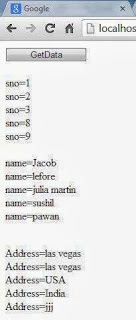
Output
How to use SqlDataReader class in ASP.NET

Sunday, October 20, 2013

ASP.NET : How to export GridView Data to Word file

The Basic algorithm behind the scene is,when i click to "Export to word file" button then GridView Data pass into word.So what steps can i take for pass data to word file.
Step-1: First bind GridView control from DataSource.
Step-2: Take a one button control for passing data from GridView control to word file.
Step-3:  For passing GridView data to word file then we must should take response object, Because if we want to get client computer cookies then we can take response object so here we use response object.
Step-4: Clear all content from response buffer using response object.

Response.ClearContent();

Step-5: Specify the word file name using Add herader method of response object with content-disposition

Response.AddHeader("content-disposition", "attachment;filename=tarun.doc");


Step-6: The next thing to do set the content type using response object.

Response.ContentType = "application/word";

Step-7:  Use two class first one is StringWriter class and second one is HtmlTextWriter class. Here StringWriter class available in System.IO namespace and inherited from TextWritter class.
Step-8:  Pass object of the StringWriter class to HtmlTextWriter class

   StringWriter sw = new StringWriter();
        HtmlTextWriter htw = new HtmlTextWriter(sw);

Step-9 : Invoke RenderControl method of the GridView class.

GridView1.RenderControl(htw);

Step-10: Pass HtmlTextWriter class object to RenderControl method. Here HtmlTextWriter class object contain Text as well as Html content( table control).
Step-11 : Invoke Write method of Response object for writing text to the word file.
Step-12 : Invoke End method of the Response object.

  Response.Write(sw);
        Response.End();
        
Step-13 : Handle "'GridView' must be placed inside a form tag with runat=server" using Override mwethod.

Complete code with output
Source code:
<%@ Page Language="C#" AutoEventWireup="true" CodeFile="binding.aspx.cs" Inherits="binding" %>

<!DOCTYPE html PUBLIC "-//W3C//DTD XHTML 1.0 Transitional//EN" "http://www.w3.org/TR/xhtml1/DTD/xhtml1-transitional.dtd">

<html xmlns="http://www.w3.org/1999/xhtml">
<head runat="server">
    <title></title>
</head>
<body>
    <form id="form1" runat="server">
    <asp:Button ID="Button1" runat="server" onclick="Button1_Click" Text="GetData"
        Width="123px" />
    <br />
    <div>
   
        <asp:GridView ID="GridView1" runat="server">
        </asp:GridView>
   
        <br />
        <asp:Button ID="Button2" runat="server" onclick="Button2_Click"
            Text="Export to word file" />
   
    </div>
    </form>
</body>

</html>
Codebehind Code
using System;
using System.Collections.Generic;
using System.Linq;
using System.Web;
using System.Web.UI;
using System.Web.UI.WebControls;
using System.Data.SqlClient;
using System.Configuration;
using System.Data;
using System.IO;

public partial class binding : System.Web.UI.Page
{
    protected void Page_Load(object sender, EventArgs e)
    {

    }
    protected void Button1_Click(object sender, EventArgs e)
    {
        SqlConnection con = new SqlConnection();
        con.ConnectionString =ConfigurationManager.ConnectionStrings ["ConnectionString"].ToString ();
        con.Open ();

        SqlCommand cmd = new SqlCommand();
        cmd.CommandText = "select * from deltable";
        cmd.Connection = con;
        SqlDataAdapter da = new SqlDataAdapter(cmd);
        DataSet ds = new DataSet();
        da.Fill(ds, "deltable");
        GridView1.DataSource = ds;
        GridView1.DataBind();


    }
    protected void Button2_Click(object sender, EventArgs e)
    {
        Response.ClearContent();
        Response.AddHeader("content-disposition""attachment;filename=tarun.doc");
        Response.ContentType = "application/word";
        StringWriter sw = new StringWriter();
        HtmlTextWriter htw = new HtmlTextWriter(sw);
        GridView1.RenderControl(htw);
        Response.Write(sw);
        Response.End();
       
    }

 public override void VerifyRenderingInServerForm(Control control)
    {
       
    }
   

}


Output

Saturday, October 19, 2013

ASP.NET: How to export gridview data in excel sheet

The Basic algorithm behind the scene is,when i click to "Export to Excel file" button then GridView Data pass into excel sheet.So what steps can i take for pass data to excel sheet.
Step-1: First bind GridView control from DataSource.
Step-2: Take a one button control for passing data from GridView control to excell Sheet.
Step-3:  For passing GridView data to excel sheet then we must should take response object, Because if we want to get client computer cookies then we can take response object so here we use response object.
Step-4: Clear all content from response buffer using response object.

Response.ClearContent();

Step-5: Specify the excel file name using Add herader method of response object with content-disposition

Response.AddHeader("content-disposition", "attachment;filename=tarun.xls");


Step-6: The next thing to do set the content type using response object.

Response.ContentType = "application/excel";

Step-7:  Use two class first one is StringWriter class and second one is HtmlTextWriter class. Here StringWriter class available in System.IO namespace and inherited from TextWritter class.
Step-8:  Pass object of the StringWriter class to HtmlTextWriter class

   StringWriter sw = new StringWriter();
        HtmlTextWriter htw = new HtmlTextWriter(sw);

Step-9 : Invoke RenderControl method of the GridView class.

GridView1.RenderControl(htw);

Step-10: Pass HtmlTextWriter class object to RenderControl method. Here HtmlTextWriter class object contain Text as well as Html content( table control).
Step-11 : Invoke Write method of Response object for writing text to the excel file.
Step-12 : Invoke End method of the Response object.

  Response.Write(sw);
        Response.End();
        
Step-13 : Handle "'GridView' must be placed inside a form tag with runat=server" using Override mwethod.

Complete code with output
Source code:
<%@ Page Language="C#" AutoEventWireup="true" CodeFile="binding.aspx.cs" Inherits="binding" %>

<!DOCTYPE html PUBLIC "-//W3C//DTD XHTML 1.0 Transitional//EN" "http://www.w3.org/TR/xhtml1/DTD/xhtml1-transitional.dtd">

<html xmlns="http://www.w3.org/1999/xhtml">
<head runat="server">
    <title></title>
</head>
<body>
    <form id="form1" runat="server">
    <asp:Button ID="Button1" runat="server" onclick="Button1_Click" Text="GetData"
        Width="123px" />
    <br />
    <div>
   
        <asp:GridView ID="GridView1" runat="server">
        </asp:GridView>
   
        <br />
        <asp:Button ID="Button2" runat="server" onclick="Button2_Click"
            Text="Export to excel file" />
   
    </div>
    </form>
</body>

</html>
Codebehind Code
using System;
using System.Collections.Generic;
using System.Linq;
using System.Web;
using System.Web.UI;
using System.Web.UI.WebControls;
using System.Data.SqlClient;
using System.Configuration;
using System.Data;
using System.IO;

public partial class binding : System.Web.UI.Page
{
    protected void Page_Load(object sender, EventArgs e)
    {

    }
    protected void Button1_Click(object sender, EventArgs e)
    {
        SqlConnection con = new SqlConnection();
        con.ConnectionString =ConfigurationManager.ConnectionStrings ["ConnectionString"].ToString ();
        con.Open ();

        SqlCommand cmd = new SqlCommand();
        cmd.CommandText = "select * from deltable";
        cmd.Connection = con;
        SqlDataAdapter da = new SqlDataAdapter(cmd);
        DataSet ds = new DataSet();
        da.Fill(ds, "deltable");
        GridView1.DataSource = ds;
        GridView1.DataBind();


    }
    protected void Button2_Click(object sender, EventArgs e)
    {
        Response.ClearContent();
        Response.AddHeader("content-disposition""attachment;filename=tarun.xls");
        Response.ContentType = "application/excel";
        StringWriter sw = new StringWriter();
        HtmlTextWriter htw = new HtmlTextWriter(sw);
        GridView1.RenderControl(htw);
        Response.Write(sw);
        Response.End();
       
    }


}


Output
ASP:NET: How to export gridview data in excel sheet

What is the need of Master Pages and Themes in ASP.NET

Introduction

A consistent look and feel is more of a necessity than a luxury for real-world Web applications. However, ensuring a consistent look and feel for the pages in Web Applications has not always been easy. In ASP.NET, developers can incorporate consistent look and feel in their applications by using features such as master pages and themes.
The concept of a master page is all about incorporating visual inheritance in Web application. In other words, you define the layout of a web page once, and all the pages of Web applications inherits that layout. When you create a master page, what you actually do is create a template page, based on which all the other pages are derived. Therefore, all the pages in the Web application inherits some common sections of that master page, which maintains consistency in the Web application.
What is the need of Master Pages and Themes in ASP.NET

Need For Master Pages and Themes 

When you want to create Web pages that contains some common elements and customize the properties of different controls, such as Buttons, TextBox and Labels, master pages and themes are needed. For example, you want to create a website for your company in which all the Web Pages have a header stating the company name and all the buttons on the Web pages are of blue color. You can create this website by using master pages and themes.
Master page is a feature in ASP.NET that helps define the overall layout of a Web application and reuse the defined layout in all the pages derived from the master page, A master page contains markups and controls that you can share across different Web page of your website . This makes your website more manageable and also avoids the duplication of code. To understand the need of master pages, Let's consider a scenario.
Suppose you want to include a navigation bar at a common place in all the Web pages of your website. If you are not using a master page , You will have to copy and paste the code for the common navigation bar on each page, which obviously is tedious and time consuming process. Also, if later you want to change the navigation bar slightly, then you will have to manually change the navigation bar code in all the pages of the Web application. Therefore, this does not seem to be a right way to bring consistency in your applications. However, if you are using master pages, you just need to include the navigation bar code in the master page, and all the Web pages will inherits it. It means no overhead of copying and pasting the code in different pages is required. Themes are needed when you want to keep the style and layout information files separate from other website files.
© Copyright 2013 Computer Programming | All Right Reserved